rTMS is not a routine first treatment for depression in children, and a machine approved or marketed for adults does not automatically establish suitability for a minor. By the end, you will know which young people might be considered, what assessment is required, how treatment works, and which questions to raise with a specialist service.
Key takeaways
- rTMS is not a routine first-line treatment for childhood or teenage depression.
- Ask for a full psychiatric, medical, medication, and suicide-risk assessment first.
- Discuss psychotherapy and established treatments before considering rTMS.
- Choose a Mumbai service with child psychiatry experience and specialist rTMS oversight.
Is rTMS approved or routinely recommended for young people?
rTMS is not a standard first-line treatment for depression in children or teenagers. Established care usually starts with evidence-based psychotherapy; medication is considered according to age, diagnosis, severity, suicide risk, and previous response. NICE guidance for depression in children and young people does not place rTMS in its standard treatment pathway.
A device’s legal availability or marketing for adults does not prove age-specific approval, safety, or effectiveness. The practical distinction looks like this:
| Age group | Usual clinical position | What requires discussion |
|---|---|---|
| Older adolescent | A specialist service may consider rTMS treatment for children and teenagers with a clearly diagnosed disorder, usually treatment-resistant major depression | Confirm age-specific evidence and whether use is on-label or off-label |
| Early adolescent | Not routine; a stronger clinical rationale is needed | Explain why psychotherapy, medication, or combined care is insufficient |
| Young child | More likely to be off-label and inadequately studied | Require a particularly strong rationale and specialist oversight |
Paediatric studies are small, heterogeneous, and concentrated in adolescents with major depressive disorder. They suggest possible benefit but do not establish rTMS treatment as equivalent to psychotherapy or antidepressants, and long-term developmental safety data remain limited.
Before agreeing, ask:
- Is this use on-label or off-label for my child’s age?
- What evidence applies to this age and diagnosis?
- Which psychotherapy, medication, school, and family-support options were considered?
- How will rTMS fit into ongoing care rather than replace it?
When might rTMS be considered for a child or teenager?
The main proposed indication for rTMS treatment for children is treatment-resistant major depressive disorder in an older adolescent with a clearly confirmed diagnosis. It is not a general treatment for distress, poor concentration, self-harm, or difficult behaviour.
Treatment resistance should be established through a structured review:
- Confirm major depressive disorder and complete adequate medication trials at appropriate doses and durations.
- Engage in suitable psychotherapy, then check adherence, access barriers, and whether treatment stopped early because of side effects, cost, transport, or other practical problems.
- Review bipolar-spectrum symptoms, psychosis, trauma, anxiety, ADHD, substance use, sleep disruption, family stress, and medical conditions before labelling depression treatment-resistant.
- Continue psychotherapy, family work, school support, medication management, and a written suicide-safety plan. rTMS treatment must not replace these parts of care.
Evidence remains insufficient for many other conditions and for younger children, so a specialist must provide a strong clinical rationale rather than treating symptoms in isolation. The evidence for rTMS in adolescents is also smaller than the adult evidence base.
If depression is urgent, severe, life-threatening, or accompanied by catatonia, compare rTMS with ECT rather than delaying effective care. ECT has a stronger, faster evidence base in these situations, but requires anaesthesia and causes more substantial short-term cognitive effects.
What assessment is required before a minor starts rTMS?
Before a minor starts rTMS treatment, a responsible service should confirm the psychiatric diagnosis and assess current and past suicide risk. It should screen for bipolar symptoms, psychosis, agitation, reduced sleep, substance use, developmental and educational history, neurological problems, fainting, seizures, head injury, epilepsy, sleep deprivation, and medical conditions that increase risk.
1. Review every prescribed medicine, supplement, and substance. Do not stop prescribed medication solely to receive rTMS; the treating prescriber must decide whether any change is safe. Identify drugs that lower the seizure threshold.
2. Check for ferromagnetic material near the head or neck, including metal fragments, clips, or implants. Ask specifically about cochlear implants, implanted electronic devices, and other medical hardware whose function magnetic stimulation could disrupt.
3. Record a baseline mental-state and safety plan, then monitor throughout the course for worsening suicidal thoughts, activation, hypomania, mania, agitation, psychosis, reduced sleep, or a seizure. A young person and caregiver should know whom to contact urgently.
Scalp discomfort, facial-muscle twitching, and headache are common effects, particularly early in treatment. A seizure is uncommon but serious, so risk assessment becomes especially important with epilepsy, neurological injury, sleep deprivation, or seizure-threshold-lowering medication. Hearing protection is also needed because the equipment produces loud clicks. Stop and reassess if safety concerns emerge.
What happens during rTMS, and what does the evidence show?
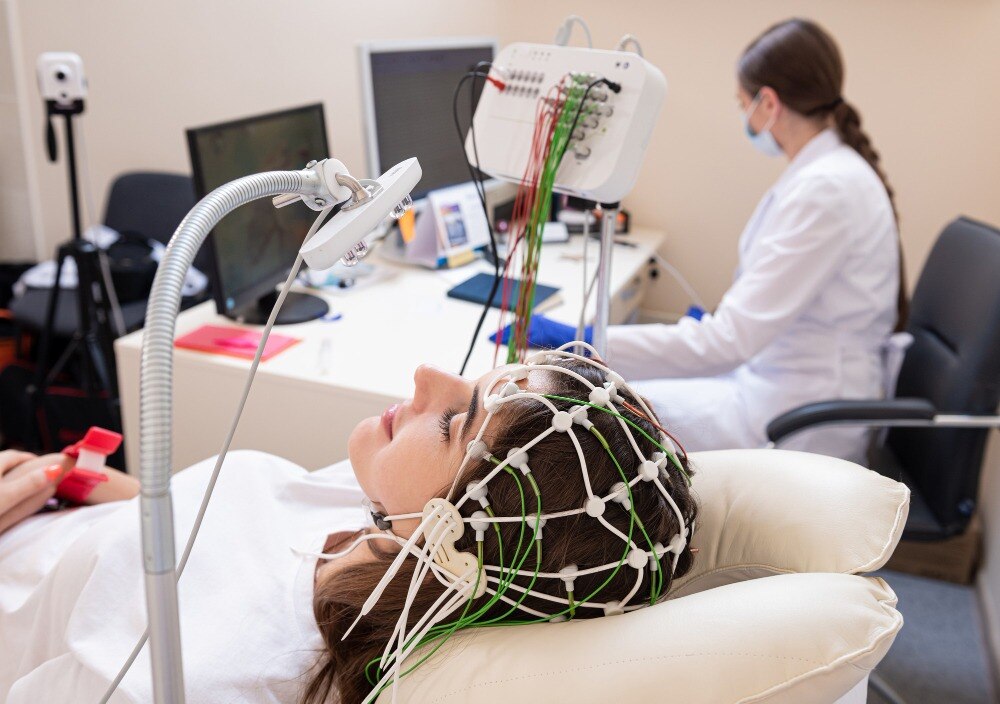
During rTMS treatment, the young person sits awake in a treatment chair and wears hearing protection. A clinician positions a coil against the scalp, then delivers repeated magnetic pulses that produce loud clicking sounds and tapping or twitching sensations in the scalp or nearby facial muscles.
Scalp discomfort and headache can occur, especially during early sessions.
A conventional course involves about five sessions each week for several weeks. Sessions often last 20 to 40 minutes, but the target, protocol, coil type and duration vary. The patient does not normally need sedation or complete stillness, but must remain safely positioned and communicate discomfort.
Sedation is generally incompatible with standard rTMS delivery, so discuss cooperation concerns explicitly before treatment.
Interpret the evidence with caution:
- Paediatric studies are small and heterogeneous, with most involving adolescents diagnosed with major depressive disorder.
- Studies use different targets, coil types, pulse patterns and treatment schedules, so their results are difficult to compare.
- Findings suggest possible benefit, but do not show that rTMS works as well as psychotherapy or antidepressant treatment.
- Long-term developmental safety data remain limited.
- rTMS does not replace psychotherapy, family support, medication management or a crisis plan.
- No responsible service can promise a lasting cure after one or two sessions.
A seizure is uncommon but serious. Risk assessment deserves particular attention when the young person has epilepsy, neurological injury, sleep deprivation or medication that lowers the seizure threshold.
How can families choose the right specialist service in Mumbai?
Choose a service for its psychiatric assessment and crisis plan, not for possession of an rTMS machine. When searching for an rTMS psychiatrist in Mumbai, confirm that the clinician is a psychiatrist experienced in assessing children and teenagers, not only an operator trained to deliver stimulation.
Ask the service:
- Who confirms the diagnosis and reviews bipolar symptoms, psychosis, medication, sleep, substances, and medical conditions?
- Who assesses current and past suicide risk and seizure risk?
- How will psychotherapy, family work, school support, and medication management continue?
- What happens if suicidal thinking, mania, psychosis, severe agitation, or a seizure develops?
- Is urgent psychiatric support available during the course, including outside the treatment appointment?
- Is the proposed use on-label or off-label for the child’s age, and what alternatives were considered?
Child psychiatry in Mumbai and child psychology in Mumbai are not interchangeable services.
| Role | What the professional provides | Why it matters for rTMS |
|---|---|---|
| Child psychiatrist | Medical assessment, psychiatric diagnosis, risk review, and prescribing where legally authorised | Identifies medical, medication, bipolar, suicide, and seizure risks |
| Child psychologist | Psychological assessment and psychotherapy; does not usually prescribe | Provides therapy and developmental or emotional assessment |
| Coordinated team | Psychiatric, psychological, family, and school planning | Prevents device-only treatment from replacing comprehensive care |
A comprehensive specialist assessment is the appropriate starting point. Dr Milan Balakrishnan’s psychiatric practice is one option for families seeking that broader evaluation, but the consultation should determine whether rTMS is suitable rather than assume it is.
Frequently asked questions
Is rTMS approved or routinely recommended for children and teenagers?
rTMS is not a standard first-line treatment for depression in children or teenagers. NICE guidance places evidence-based psychotherapy and, when appropriate, medication in the usual treatment pathway rather than routine rTMS.
When might rTMS be considered for a child or teenager?
A specialist may discuss rTMS when depression is severe or persistent, established treatments have not helped, and the potential benefits outweigh the uncertainties. The decision requires specialist assessment and family involvement.
What assessment is required before a minor starts rTMS?
Assessment should cover diagnosis, symptoms, suicide risk, medical history, medicines, previous treatments, developmental factors, consent, and the young person’s ability to tolerate the sessions.
What happens during rTMS treatment?
The young person sits awake while a magnetic coil delivers repeated pulses to a targeted area of the scalp. The specialist explains expected benefits, side effects, session frequency, and how progress will be monitored.
How can families choose the right specialist service in Mumbai?
Ask whether the service has child psychiatry expertise, a named psychiatrist supervising rTMS, a documented emergency and suicide-risk plan, informed-consent procedures, and a clear alternative-treatment plan.
Keywords